 |
 |
 |
 |
 |
 |
 |
 |
 |
 |
 |
 |
|
| |
|
|
| |
|
|
| |
|
|
| |
|
THE SHIPS
"Four Stacks, Flush Decks" identified a type of destroyer that first entered the US Navy in 1917 with the introduction of the CALDWELL class. Earlier destroyers also had four stacks, but had a raised fore deck for the gun mount, and their armament was lighter. "Flush Deckers" were produced in three classes with a total of 273 vessels joining the fleet by 1922. They were built at various shipyards up and down the East and West Coasts, primarily by Bethlehem Steel, but also by Bath Iron Works, Cramps, and NY Ship.
The first of the type was CALDWELL (DD-69), followed by her class with a total of 6 ships. Then came WICKES (DD-75), the prototype for a 111 ship class. The type ended with CLEMSON (DD-186)class, consisting of 156 vessels, for a total of 273 ships that came to be known as the Four Stackers. The next class of destroyers was headed by FARRAGUT (DD-348), which departed radically from those earlier designs, having only two stacks and being larger and carrying different armament.
The three classes (CALDWELL, WICKES and CLEMSON) were nearly indistinguishable from each other. They were 314'-4" long, between 30'-2" and 30'-10" beam, 9'-2" to 9'-10" draft, and between 1100-1300 tons displacement. The hulls were of all-riveted construction with an 18" I-beam keel on which 177 frames were mounted. Hull plating ranged from 0.44" to 0.24". The ships were powered by two turbines with steam supplied by four boilers, providing between 24,200 and 27,000 Shaft Horsepower. Their maximum design speed was 35 kts, with a range of 3400 NM at 20 kts. They had twelve water-tight compartments and four oil-tight bulkheads. They all carried four 4 in/50 MK12 guns as main (anti-surface) armament, and a single 3"/23.5 MK 14 gun for anti-aircraft use. This was supplemented initially by two .30 caliber machine guns. Their primary anti-ship weapon in the attack role was four triple-tube 21" torpedo launchers. For anti-submarine operations they were equipped with one Y-gun and two depth charge racks. Throughout their years of service many changes were made to the individual ships, resulting in a wide range of variations, especially in armament configuration. Many of these vessels were converted to APDs (fast armed personnel transports)later in WWII, which meant removal of two of the stacks and other less obvious modifications.

It bears remembering that these ships were not that far removed chronologically from the age of sail. As such, they included little of what we today would see as 'givens' in steel hulled, steam powered ships. For example, their anchors were of the stocked type, and stowed in depressions on the exposed foc'sle. The bridge was open, with only canvas dodgers fitted for protection from the elements. The guns were mounted in the open, without turret armor except for a lightweight deflecting shield in front of the gunners. The guns were manually operated and directed, with the gunners located in tractor-type seats on either side of the gun, sighting through telescopes attached directly to the gun on a yoke. The crew's quarters served as berthing and messing decks in one space, as on ancient sailing vessels. There was a small galley in a deck house aft, accessed only by transiting the open main deck. Pails were the only means of washing up, as there were no sinks or showers. A 'sluice' served for the crew's head, consisting of a trough with a constant flow of sea water running through it and crude wooden seats positioned along its length. As on sailing vessels of old, there were no allowances made for privacy from one's neighbor.

These vessels were truly 'lean, mean fighting machines', efficient and fast even if they were spartan in their accomodations. As such, they played an important role in the early days of WWII when the German U-boat threat loomed and more modern vessels were still only on the drawing boards. Great Britain found itself severely short of convoy escorts against the submarine threat upon the opening of hostilities in 1939, and the United States made its first steps out of neutrality by providing the UK with 50 WICKES class four-stackers. One of those 50 lend-lease ships became probably the most-modified when the British prepared CAMPBELTOWN (formerly USN BUCHANAN DD-131) for use as a block ship on a raid on the dry dock facility at St. Nazaire. She was modified to look like a German MOWE class Torpedo Boat and sailed directly into the gates of the dry dock, where 4 tons of explosive packed in her bow detonated and destroyed the target. This single raid by an obsolete WWI destroyer guaranteed that the German Battleship TIRPITZ would never be a menace to the Allies again, as the facility at St. Nazaire was the only location that TIRPITZ's earlier battle damage could have been repaired. An even earlier arrival of four-stackers is commemorated in a painting of several American destoyers steaming in off the horizon entitled "The Return of the Mayflower" which depicts the arrival of the first US vessels to aid the British during WWI. Note, however, that these destroyers were not 'flush deckers', as they had a raised forecastle, distinguishing them from the more numerous ships of 'four stacks and flush decks' fame. 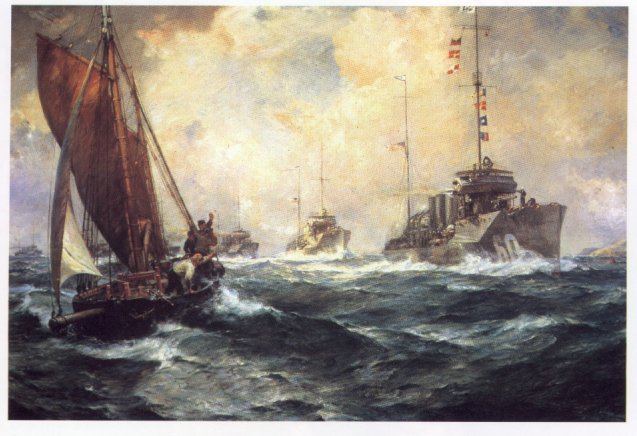
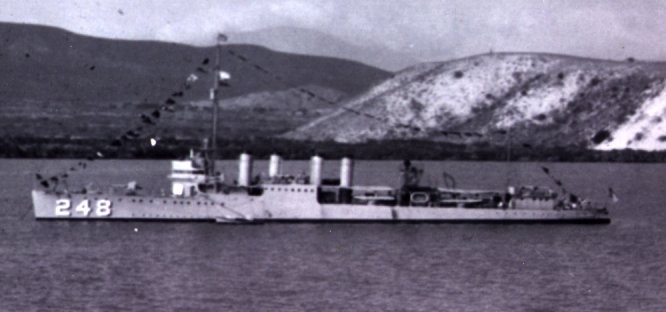
My personal interest in this type came when, as a youth, I heard my father describe his experiences aboard BARRY (DD-248) prior to and during WWII. BARRY was a typical four-stacker, with very few modifications from the original when he joined her crew in 1940. This proud ship carried him over the world's oceans for 5 years, seeing action in the waters near Panama and the Galapagos, in the North Atlantic, off the coast of Nazi-held France and in the Mediterranean before finally meeting her end in the Pacific. He spoke little of the war, but much of the ship and the men who served aboard her. Those discussions told me a great deal about who he was and how he became that person. They also served in some part to shape the person I am today.
This page, and all contents, are Copyright (C) 1999 by Kenn Anderson,Sr., Scranton, PA. (USA)