 |
 |
 |
 |
 |
 |
 |
 |
 |
 |
 |
 |
|
| |
|
|
| |
|
|
| |
|
|
| |
|
THE MEN
 |
|
|
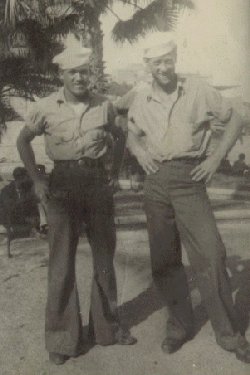 |
It is difficult to separate the men who served aboard these destroyers from the ships themselves. The men served the ships and kept them running, yes, but the ships served the men by transporting them, feeding them, and giving them the tools they needed to fight for their lives. |
|
|
The men and ships were uniquely suited for each other in time and temperament. They had to be. The ships provided little in the way of creature comforts for the crew, but the crew didn't need or expect much. Many of the men had grown up on farms where water came from a handpump in the farmyard, transportation was provided by shank's mare or the plow mule, and if you had light to read by at night it came from an oil lamp. There was no indoor plumbing in their world, and little to occupy their day but work. Those who joined the Navy in the 30s did so in part to escape the poverty of the Great Depression. Electric motors were considered high tech. The ships suited these men, and the men suited the ships. |
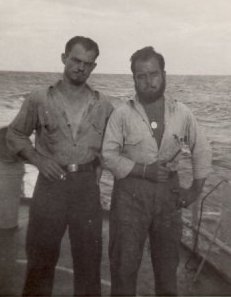 |
|
|
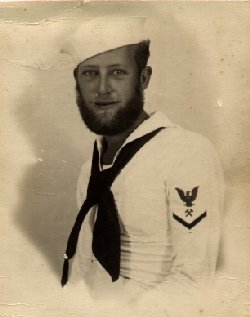
I never personally saw a four stacker - the ship, that is. But I knew my father, and he had become as much a four stacker as those 1200 ton assemblies of steel. He grew up in rural Southern New Jersey, one of six sons and one daughter of a share-cropping farmer. He knew little of luxuries, entering his teen years at the height of the Depression. There were always chores to be done around the farm, even for the youngest. Digging potatoes and shelling corn, rounding up chickens and chopping firewood. As soon as the boys were old enough to shout "GEE" and "HAW" with enough conviction to make the mule know they meant it they were in the fields plowing. The only heat in the house came from the cook stove in the kitchen, and there was never enough wood to spare to keep that going all night. Washing up was done in your room with a pitcher and basin. Life was hard, but no harder than anyone else's, so they didn't expect any more. |
|
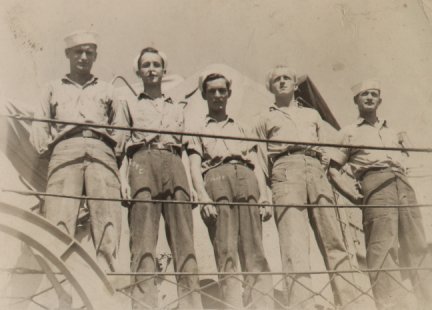
For such a man, and there were many such men, to join the Navy and go aboard a four stacker was not as much hardship as it would be for us. There were three square meals every day, a bunk or hammock to sleep in and interesting ports to visit. There was work to do, and tools to do it with. There was electricity for lighting, and running water (at least to fill your wash pail with). There was the structure of command to give order to everyone's lives. Yes, these men were suited for duty aboard a four stacker. |
 |
|
 |
The ships themselves were as simple as their mission would allow. Electricity and steam were the height of their technology. Most of the mechanisms were no more complex than would be encountered on a 1920s farm tractor, although not all the men had ever had occassion to work on one of them. Only a handful of men aboard needed real specialty skills in things like radio operation and repair. The other trades were learned by apprenticeship - boatswains mate, shipfitter, quartermaster. You came aboard a farmer and became a seaman in time. |
|
|
I can remember my father working on our family car on the weekend, or the lawnmower in the evening. He might remove a worn part and take it to his workshop in the basement. There he would pull down coffee cans full of 'odds and ends' - nuts, bolts, parts from who-knows-what, and begin to look for something to repair the current project with. The fix would most likely be unconventional in the extreme, but it would work until a new part could be afforded. Sometimes the repair worked so well it was just forgotten and became permanent. Some of that attitude came from his early years on the farm, but the ability to keep things running with bits of nothing came from his time aboard ships. He had become a Four Stacker, and he wasn't alone. |
 |
|
 |
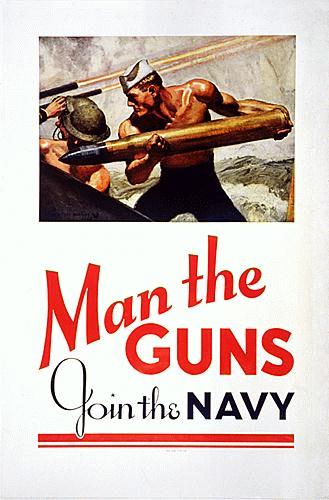
Men like these, and others who served aboard similar ships at the time, are who made our country what it became after WWII. They came home and applied that same energy, drive, and willingness to perservere through hardship. It didn't occurr to them to take life easy, or ask for a handout. Our neighbor across the street had also served aboard four stackers. He exhibited the same qualities of 'can do' in his home and work. One summer evening he and my father were chatting with a third neighbor on his crumbling concrete steps. A five minute discussion between the two of them about what best to do with the situation resulted in them wielding sledge hammers and demolishing the mess before the owner had a chance to protest. They had a new set of steps poured by the weekend, and those steps are still there fifty years later. Men like these weren't the exception, they were the rule. |
|
This page, and all contents, are Copyright (C) 1999 by Kenn Anderson,Sr., Scranton, PA. (USA)