 |
 |
 |
 |
 |
 |
 |
 |
 |
 |
 |
 |
|
| |
|
|
| |
|
|
| |
|
|
| |
|
I went through boot camp at San Diego in 1937. San Diego harbor at that time was home to destroyers, submarines, a couple of light cruisers (I think one of them was the Detroit) and an old aircraft carrier.

At about the time we were to graduate from boot camp we were asked for our preference of ships to be stationed on. I looked out over the harbor and spied one of those brand new destroyers, I don't recall their numbers but they were in the 300 figure. That is what I requested, destroyer 3xx.
After graduation day myself and another fellow was loaded onto a whale boat and out into the harbor we went. You must remember at that time that we carried everything with us. Seabag and hammock lashed together with a bucket swinging from one end and a ditty bag from the other and keep in mind that this boot only weighed 120 pounds soaking wet.
Our first stop was the tender Altair that had four cans alongside of it and which, by our approach we couldn't see. To reach the deck of the Altair was a long climb up the ladder. Upon reaching the gangway watch, saluting the flag and officer of the deck we were informed to go down a hatch, three decks down (it could have been four) and go out a side hatch and that our destroyer to which we had been assigned was on the outboard side of the four.

Never had this 17 year old skinny kid ever carried such a load down a steep ladder, let alone going down three decks.
My first experience in learning that the Navy never really gives you what you want was when I hit that open hatch that showed the type of ships that we had been assigned to. The ships were undergoing a lot of repairs, there was air hoses, steam hoses and lines of all types lying all over each of the three cans that we went across until finally we got to ours, the USS DALLAS DD199. Was I disappointed, you bet I was.
Why didn't the whaleboat take us to the outboard destroyer in the first place? That still remains a mystery to this day.
After handing in our orders at the gangway we were both interviewed by the Engineering Officer who was looking for men to work either in the engine rooms or firerooms. We each declined and I was assigned to the deck force.
As luck would have it (this was on a Saturday) my section had liberty that week end and this boot took off for my home in San Fernando Valley.
Upon reporting back aboard on the following Monday morning at 8 a.m. I was introduced to chipping paint, wirebrushing what had been chipped and painting with red lead paint what had been wirebrushed. This was an all day thing and I was told after sweeping down and swabbing down the deck at about 4PM that there was more in store for me the following morning but in a different location, back towards the stern.
The following morning I was awakened at the awful hour of 4:30 a.m. We had to sweep down and swab down the decks before breakfast!
After breakfast, which was served at 6 a.m., in our quarters, no mess hall on these things, I was on my way to the aft section of the ship where I had been assigned to commence my chipping, wirebrushing and painting job when I passed an open skylight. Looking down into the space below what should I see but men still in their bunks. "What in the blazes is this?" I turned to one of the other fellows going by and pointed below and asked him just what was going on.
He informed me that the aft quarters were for the "black gang" and that they didn't have to get up as early as the deck force did. WELL! The wheels of this kid's head started spinning and the first chance I got I asked for permission to see the engineering officer. That very day I was assigned to one of the engine rooms. Did I enjoy sleeping in? yep! Did I escape chipping and painting? Nope. I found myself in the bilges doing the same thing, but I did get to sleep in.
Incidentaly, I did make to one of the new destroyers a little over a year later. It was the Worden DD352. I also served on the Orleck DD886 and on the Shea DM30 and there was the DE I forgot the number but it was the Rueben James, named after the James (a fourstacker) that was sunk off of Nova Scotia .
PS: The Worden DD352 ran aground in Alaska during a storm and broke up. The Orleck DD886 was given to Turkey awhile back. The were going to scrap it but the Orleck Family and the city of Port Orange, TX (where it had been built) got together and got the Turkish Navy to donate it to the family and Port Orange. They put on a big drive to raise the money to have the ship towed back to TX and it recently arrived in Port Orange where it will be come a museum.
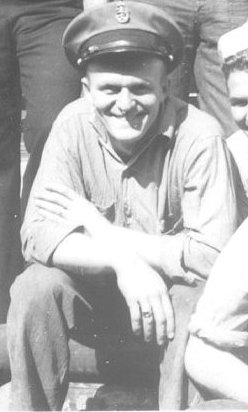
I entered the Navy on May 1st, 1939 and was sent to Newport Rhode Island for boot camp, which was 90 days of vigorous training. I was 17 years old and had dropped out of High School because I flunked English I, II, and III, but passed German I and II.
I served newspapers on roller skates in Philadelphia and delivered the 'BULLETIN'.
My first job was as a choir boy at 8 years old. I sang at Christ Church in Philadelphia - that's where Washington and Jefferson, et. al attended services. We had three rehearsals each week - one on Monday afternoon at 4:00 PM. I got paid 15 cents for an hour and was given two trolley tokens - one to get home and one to get back. This was repeated on Wednesday. Friday night we rehearsed with the men - tenors, altos and basses - and got 25 cents and more car tokens. Sunday we (all 24 boy sopranos) and the men sang at a morning service and also an afternoon service. It was Sunday and we didn't get paid for that. We did, however, get 35 cents for lunch.
There was a chain of Horn and Hardarts' Store on Market Street in Philadelphia, called an Automat. You put a nickel in a slot and a door opened to supply you with a bowl of soup, a sandwich, a pot pie, desserts. Twenty-five cents will fill you well. The dime left over I used for myself. The money I got paid for the rehearsals I gave to my mother, as times were tough.
At age 12 my voice cracked and I had to leave the choir. I then got a job in a tailor shop, delivering clothes. I got paid 5 cents per delivery, whether it was a lightweight dress or three suits, two overcoats, etc. I did that on roller skates. I learned how to use the steam press to press suits, etc. I got tired of that and then did the paper route. I served 100 papers, six days a week. Grossed 5 cents per cutomer per week. Five bucks! - Good money. Some people wanted the 3 Star Special, which had the ball scores in it and I waited outside a candy store for an hour or so to pick up ten papers.
The store owner told me to come in out of the rain and/or snow. Then he asked me to care for the store when he would go home for a nap. All the candy and ice cream and cigarettes for free. Today I can't stand the smell of candy!
At any rate I looked to the future and saw an ad in the paper about joining the Navy. So, I went down to Market Street in Philadelphia and when I got there the line to enlist started at 10th Street, went a block down to Chestnut and back up to Tenth Street to the door of the Enlistment Center. Somone told me they were only taking two people per week. There must have been 500 guys in that line.
The following Tuesday morning was raining rather heavy and I went down at 5 AM and was first in line. I got inside, had a physical, passed that and got a train ticket to Newport RI. Arrived at Naval Train Station at 2 AM. Got a Navy hair cut 1/4" short and three shots in the arm. There were 50 men/Company and 14 companies and you stood in line outside waiting to get in the chow line.
After three months of training, as Seaman Apprentices we graduated and went home on boot leave. Raised from $21/day "once a month" to $30.
Went to Norfolk, Virginia and on to a battleship - USS NEW YORK BB-34 - Slept under the #3 turret and was transferred to the USS BARRY about a week later.

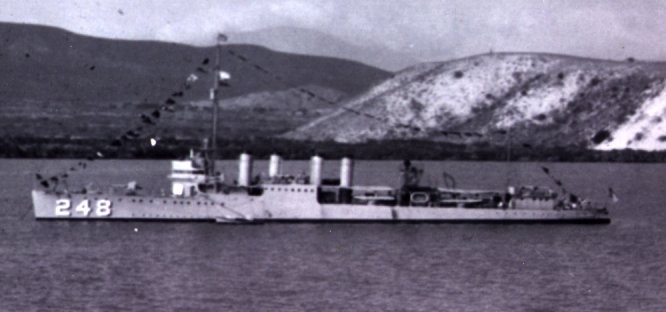
It was a bucket of rust. Scrub deck, chip paint, and paint some more. Needed to get done. Ship's full complement was supposed to be about 120 men, there were only 45 guys on it then. I was lucky. I got a job as an electrical striker, as I'd had an electrical course in High School. I went from Fireman 3/c to Chief Electrician's Mate. That paid $114/month plus 10 per cent for sea duty, and I did plenty of that.
I became movie operator and that paid a dollar a show. Made more money there than my regular pay! Was in a lot of combat zones around the would and was later tranferred to Todd Erie Basin in Brooklyn NY for fitting and commissioning.

Was married and lived in Sarah's apartment for six months, then went to sea again on a hospital ship, the USS HAVEN AH-12. There were six of these built to be used to setup up field hopsitls fter the A Bombs were dropped in Japan. I got as far as Okinawa, the was was over and I was asked to ship over and maybe given a commission as Chief Warrant Electrical. I turned that down and was put on the beach at Okinawa - after six weeks living in a pup tent on the beach I was transferred to the USS TEXAS BB-35. Got to Pearl Harbor, transferred to a cruiser and went to San Francisco. There trains were waiting to take us to either Norfolk, New York, or Boston.

When we got to the Rockies the engines couldn't pull the grade so they added on other engines, and then went back to the next train. All the baggage got mixed up and it was three weeks after my discharge that I got my gear.
I looked for a job in the New York area nad couldn't find one, as there were 20 million guys getting out of the service and no place to put them. So I told my wife I would go to Philadelphia and hope I had better luck and I did. I got a job with G.E. Company . . . . . .
This page, and all contents, are Copyright (C) 2000 by Kenn Anderson,Sr., Scranton, PA. (USA)