 |
 |
 |
 |
 |
 |
 |
 |
 |
 |
 |
|
| |
|
|
| |
|
|
| |
|
|
| |

As we celebrate Christmas with our family and friends, I am reminded of another era and a Christmas that wasn't so joyus.
On 17 December, 1943, CTG 21.14 commanded by Captain A.J. Isbell aboard the USS Card (CVE-11), left Casablanca and steamed in support of convoy GUS-24. Orders from Washington detached the Card group, Leary (DD158), Schenck (DD159), Decatur and Babbitt, to track down a U-boat concentration around latitude 45N, longitude 22W. The Card was one of the "jeep" (escort) carriers and the destroyers were old WWI vintage four-stack destroyers.
At daybreak on 23 December, around 47N, 19W, about 695 miles west of St Nazaire, the weather turned foul. A Wildcat from Card spotted a merchantman flying the red ensign. She refused to answer the aircraft's challenge and the ship's colors were suspected false. Due to the foul weather and low fuel, the Wildcat was ordered to return to Card without pressing an attack. Capt. Isbell dispatched the Schenck (pronounced "Skeenk")to investigate. Card halted all flight operations due to the weather. Capt. Isbell learned that this ship was the German blockade runner Orsono and was carrying a load of rubber for the Reich. Remembering that the Orsono caused the loss of the British ships Rodman and Laurey, Isbell recalled the Schenck. This was a good decision, the Orsono was escorted and heavily guarded by U-boat group Borkum (the group they had been sent to investigate).
A Luftwaffe patrol pilot was searching for Orsono and spotted Card. Her position was radioed to Admiral Doenitz. Doenitz ordered Group Borkum to pursue Card.
Just before dusk on the 23rd, the seas were so rough that a Wildcat and her crew were lost from the deck of the Card. An additional sailor was swept off her flight deck. While the air crew was recovered, the sailor was nowhere to be found in the rough seas. Decatur's steering gear room was flooded and she was being steered by hand. Two groups of men were directed to haul heavy lines along the decks of Decatur to steer her in the rough seas. These lines were connected to a huge tiller. Decatur was out of action and in dire straits.
Capt. Isbell had no way of knowing that group Borkum (13 subs) had rallied and lay in waiting for their prey 85 miles dead ahead. With the rough seas and the stricken Decatur, Isbell could not evade the group and decided to press ahead. The die was cast.
At 2120 on December 23rd, Schenck picked up an increase in radio activity and informed Card. Schenck engaged the lead member of Group Borkum. At 2200, U-305 sighted Card and ordered the wolfpack to close. At 2230 Card's radar picked up her first surface contact. Soon, there were too many to track. Card, with Decatur in close proximity had to make best speed dead ahead to outrun the wolfpack. Captain Isbell reported, "at one time our own CIC became so confused, we had to turn on the SK radar to observe our own ships ABKs so we might differentiate between our own destroyers, the two subs on our port beam and the subs on our starboard quarter."
Card had only three escorts and her aircraft were not equipped for night flying. If Capt. Isbell were to open fire on the surface targets with his guns, their position would be silhouetted and she was sure to catch a fish. Schenck was running down numerous contacts to the south and was ordered to continue the attack. Leary and the stricken Decatur followed the Card and took evasive action.
Things began to happen in rapid succession. The heat was on and the ships were in the middle of a cauldron of war and mother nature's fury. Card's evasive course took her into range of U-415, which she sighted as a "large black trailing object" 3700 yards astern. She was unaware that this "object" had already fired a salvo of three torpedoes at her. They all missed. Schenck , surrounded by multiple contacts, was on an attack run with U-305 and radioed to Card for assistance. She was outnumbered and surrounded. Card dispatched Leary to assist and made best speed with Decatur in hope of daylight for an air strike. Isbell signaled Leary over the TBS, "Keep subs down during the night. Rendezvous at 0600, forty miles SW of Schenck's last contact. Good luck." Several subs pursued Card through the night. At 0630, she was able to launch her first aircraft and a sub was immediately spotted 7000 yards on her port quarter. The subs dove under the safety of the waves and Card was spared.
Meanwhile, the two destroyers, Schenck and Leary were engaged in battle with the remainder of Group Borkum. Schenck , commanded by Commander Earl Logsdon, scored several hits and an attempted ram on several targets. Torpedoes were seen in the water heading for Schenck. The closest was one that went right under her bow. A wave had crested just in time and the Schenck was spared. She steamed towards Leary to join in a systematic search of the region.
At about 0130, 24 December, the destroyers made three radar contacts 5 to 7 miles north. As Leary moved out to chase the more distant, Schenck made a 4th contact and lost it at about 2500 yards. She sighted a U-boat diving and evaded a torpedo to port. She closed to 800 yards and at 0145, began a nine depth charge pattern. The U-boat was damaged and surfaced at 0215. Schenck closed for the coup-de-gras. The boat dove. It was located at 1900 yards by sonar, just under the surface. Schenck closed and dropped a shallow nine charge pattern. At 0229, secondary underwater explosions were heard and a brief surface contact was made. A distress signal was intercepted. As Schenck closed on the stricken U-boat, she slipped under the waves with no survivors. An oil slick surfaced. This was the end of U-645. The U-boat sank with 55 men and group Borkum's Doctor.
A series of mishaps were rapidly occurring aboard Leary. At 0158, Leary commanded by Commander James Kyes, made radar contact and fired a star shell to illuminate the target. This only illuminated her own position for the shadowing subs. As the sub submerged to periscope depth, there was a misunderstanding and Leary's guns continued to fire. The noise of the guns and the foxer gear (homemade anti-acoustic torpedo device) prevented any acoustical contact. At 0208, when sound contact was gained, the squawk box between the sound room and bridge failed to function and almost two minutes elapsed before Commander Kyes got the word, and, too late, ordered right rudder.
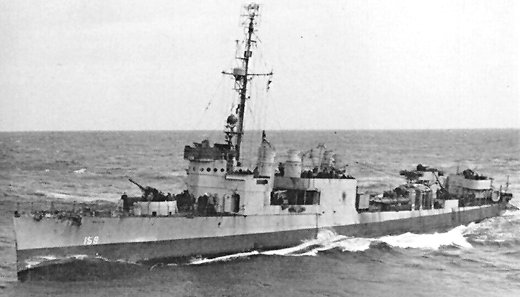
U-275 had been watching Leary for almost ten minutes. At 0210 as Leary commenced her turn, Oberluetnant Bork fired two well aimed Zaukoning torpedoes. They hit Leary in rapid succession. One in the after engine room, and one in the after hold. All power was lost. The crew in the engineering spaces were killed outright by severed steam lines. She listed to starboard by 25 degrees and settled rapidly. The torpedo men barely had time to safe her depth charges. This action undoubtedly saved many lives. The entire aft section of the destroyer became a tangle of twisted metal and human lives extinguished. Leary began to break apart and settle. RT Butch Hauer started the auxiliary generator and called to Schenck for assistance. As Schenck was taking an oil sample, Leary five miles distant, had reported that she had just been torpedoed. U-275 's fish had hit their mark. Schenck headed at flank speed to aid her sister.
One sailor was thrown across the deck and landed under the main engine room vent. As he lay there in shock, a blast of searing steam scalded him with 2nd and 3rd degree burns to the legs. He could hear the men in the engine room screaming for a brief moment.
As the ship began to settle, the shoes were all lined up by the gunwalls in an orderly fashion, as if their owners would soon return. One sailor leaned over the rails and ask a buddy, already in the water, "is the water cold?" The sailor yelled back, "does it really matter?" On the fantail gunmount, a tragic drama was unfolding. Donnell Smith, GM3c was manning the gun when the first torpedo hit. He was knocked from the mount and pinned under the wreckage. Blondy Smith, Donnell's brother, was frantically searching for his little brother. He found him under the gun. As the ship settled and the water rose, Blondy and others tried to lift the gun and wreckage from his brother. There was no hope. Blondy held his brother's head as it slipped hopelessly under the waves. His brother was gone.
| I recently received an e-mail from the daughter of Blondy Smith. She writes to inform me that her father had served on USS LEARY with his brother Donnell, but had been reassigned in May of 1942, however, and at the time of this incident was serving on USS PUMPER. The family has very little information about the exact circumstances aboard LEARY that night, but has been told that Donnell was pinned under something, and went down with his ship. -Kenn |
Three or four minutes after the explosions, the XO, Lt. Robert Watson, concluded a quick inspection. He reported to Commander Kyes. Kyes ordered abandon ship. BM Walter Eshelman directed men to jettison all floatable gear and abandonment was professional and orderly as if a drill. Watson reported that everyone except himself and the skipper had left and obtained permission for one more look around to see if any wounded men had been forgotten. U-382 had moved into position and launched a third torpedo. It struck at 0241 in the forward engine space. Leary broke apart and went down fast. Commander Kyes ordered Watson and Hauer over the side and handed his life jacket to a black mess attendant who had none. Commander Kyes was never seen again.
As the ship slipped beneath the waves, her bow rose high in the air. The steam escaping form the spaces and the constant blowing of her distress horn made an eerie, haunting sound. Men swam away from her as fast as they could, dragging the injured and weak behind them. They had to escape the suction of the ship, and any secondary explosions from unsafed depth charges.
Over 60 men were killed instantly by the explosions, and about 100 were now in the 43 degree water.
As Schenck arrived on the scene, she could not pick up survivors. The water was infested with Group Borkum. A rain squall developed and pounded the waters. In a bold move, Cmdr. Logsdon slowed Schenck and dropped her gig in the water with four men aboard. He gave the order to a young Lieutenant (jg), "Save as many as you can. I don't know when we'll be back. Good luck and may God be with you." With that, the gig was in the water among the survivors. Schenck pressed on to chase Borkum out of the area.
In the water, there was no officer, no enlisted man, no black, no white. They were all sailors fighting to stay alive. Afraid that, at any moment, a U-boat would surface and machinegun them all. Not only were they fighting the enemy, they were now fighting the cruel sea. One by one, they slowly succumbed to their injuries and slipped beneath the waves. The strong fought to hold on to the wounded, but their hands and arms ceased to function.
Four hours later, when day broke on Christmas Eve, Schenck returned to the site. She slowly steamed among the debris and bodies. Her crew tried to identify the dead from the names stenciled on their clothing. She pulled 59 hypothermic and injured men from the water. 97 United States sailors perished on Christmas Eve of 1943 in the icy North Atlantic.
Later that day, Schenck rendezvoused with Card and Decatur. She refueled and transferred the wounded.
It is ironic that Schenck and Leary were built side-by-side. Leary died while her sister fought to save her.
While lives were lost that night, heroes were born. I, and my brothers grew up with the story of Christmas Eve of 1943. That fateful night was relived every year by my dad who was on the Schenck's radio that night. He sent and received all of the radio messages that were sent that night, fortunately, he kept copies of all of them. That incident profoundly affected his life and ours. As we look around and see veterans from this war, we will see some who will not be with us next year. I heard a staggering statistic, we lose 1,000 WWII veterans every day. With them goes stories of hardships, survival, and heroism. History books will re-write these stories in Disney/politically correct fashion. This has become known as historical revisionism. It is up to our generation and us as historical interpreters to preserve the truth, to preserve the facts and the real story. Politically correct or not, it is history and it is our heritage. Look around you. Look at the older generation. Thank them, these guys are the heros. They saved the world from a little man named Hitler. Without them we wouldn't be saluting the Stars and Bars, we would be hailing a swastika. From my generation to the men of the ships represented here, on Christmas Eve of 1943, you all became heros. Thank you.
My dad, CRT Elmer "Robbie" Robinson, was proud of his old four-stack tin can, the Schenck. She was an out-dated WWI vintage rust bucket that needed continuous repair and leaked like a sieve, but she was fast and maneuverable with a top-notch crew. She was commanded by a man who had the uncanny ability to out-think the U-boat commander. Dad always talked about the antics of the ship and crew. In November 1991, dad died quietly at home. He was buried in his beloved North Atlantic, by an AEGIS cruiser crew, among his shipmates who were lost on Christmas Eve of 1943. God bless him and all sailors from all wars who were lost at sea.
This page, and all contents, are Copyright (C) 2000 by Kenn Anderson,Sr., Scranton, PA. (USA)